
Start a West Valley City Name Check
Write down the person’s full name and every variant before searching. Include a maiden or former name, hyphenation, initials, suffix, transliteration, and the spelling used in an old directory. Then choose the record that matches the purpose. An Assessor hit says something about a parcel owner. A court hit says a person appears in a public case. A license hit says a state-regulated credential exists. None of those labels means current occupancy by itself.
- Set the time and place: West Valley City, Salt Lake County, or an earlier Granger or Hunter label.
- Test the Assessor by owner name and compare parcel, situs, and mailing fields.
- Run Utah Courts Xchange with a narrow court, case type, date, and wildcard variant.
- Use voter status, vital indexes, Commerce, or DOPL only for the specific record question.
- Confirm the strongest hit with the custodian and keep unrelated same-name records apart.
The county and state systems do not share one identity key. A matching surname and city is not enough, especially in a large place with common names and historical labels.
Separate Owner, Party, and Occupant
Record labels prevent the most common error. An owner holds a recorded property interest. A registrant appears in an election system. A party is named in a court matter. A licensee holds a professional credential. A business principal or registered agent is tied to a filing. An applicant or contractor may appear on a city permit file. An occupant is the person actually living at the address, and public records rarely establish that fact for everyone in a household.
| Record | Useful confirmation | Important limit |
|---|---|---|
| Assessor / GIS | Parcel owner, situs, possible mailing or exemption context | Owner is not automatically occupant. |
| Recorder index | Recorded party, date, instrument, legal description | A deed is not a current address trail. |
| Xchange | Case party, court, type, disposition, event | Private and sealed records are excluded. |
| Voter lookup | Status and polling information | Not a public street roster. |
| DOPL / Commerce | License, business, principal, or filing role | Business location is not a home address. |
Use two independent identifiers before combining records. Address plus name is a start, not a guarantee. Add a case date, occupation, spouse or relative, age range, parcel, or business role when the source makes that field public.
Use Xchange Narrowly
Utah Courts Xchange covers Utah district and justice courts, including West Valley City Justice Court. Its search offers jurisdiction, district or justice choice, case number, last name or company, first name, case type, and date range. The help page documents an asterisk wildcard for spelling variants, initials, and suffixes. Search results can reach 500, so add a court, county, type, or date before you submit a broad name.
Visible result information can include a case number, party, case type, filing date, court, judge, disposition, hearing or event, and selected public case history. Search access is billable and electronic documents usually cost separately. West Valley City’s local court page provides a request form for permitted records, eligibility, certification, payment consent, and signature. It reports one to three business days, and a 3% nonrefundable card fee effective April 1, 2026. Federal matters go through PACER and District of Utah CM/ECF.
Open the official source before relying on this image.
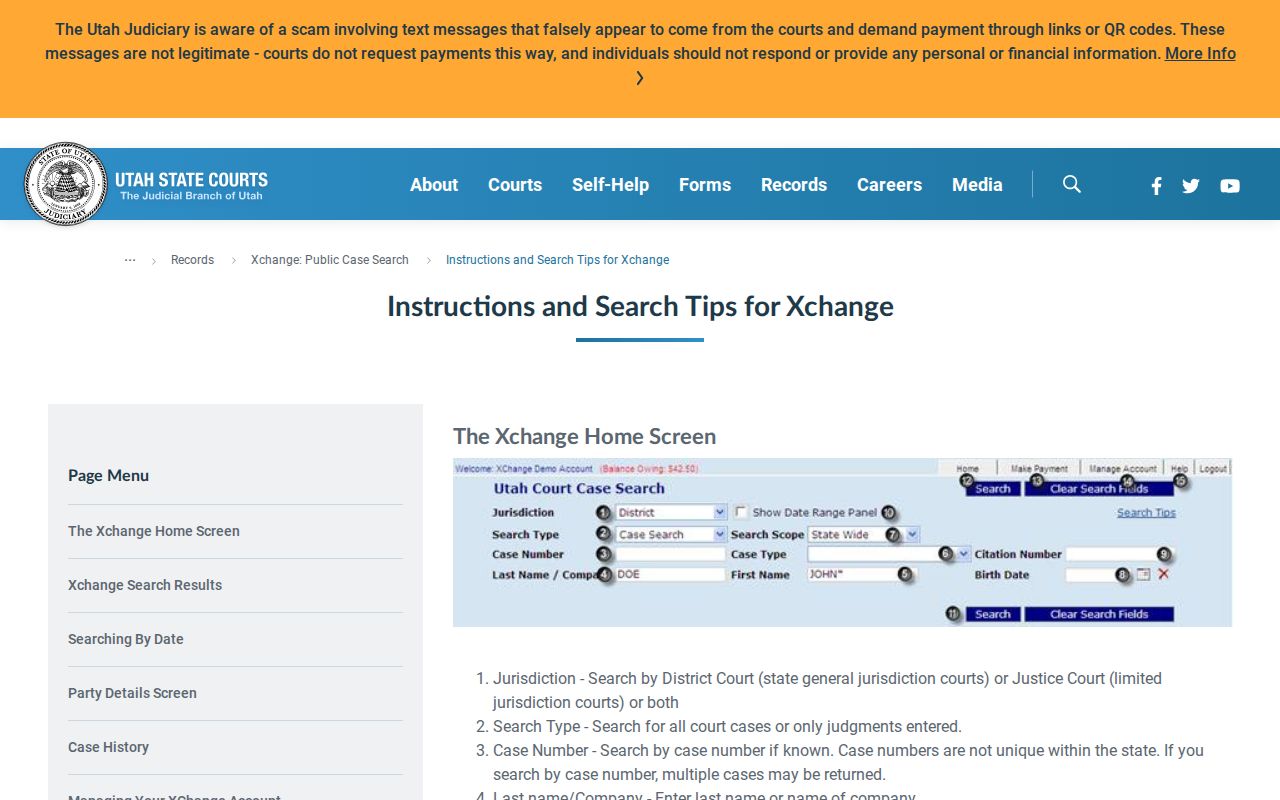
The help capture is a useful reminder to narrow wildcard searches and read each case field instead of merging names by guesswork.
Voter Records Have Guardrails
The official Utah voter lookup is a status and polling tool. The live controls were not exposed in the research capture, so exact search fields should not be promised. A full voter-file request is separate. Utah election pages describe public fields that may include name, voter ID, age range, residential and mailing fields, county, precinct, districts, party or unaffiliated status, active or inactive status, last update, and vote history.
Full date of birth, Social Security number, driver-license or state-ID number, email, phone, signature, and protected At-Risk records are not ordinary public fields. Salt Lake County’s 2026 SB153 transition page says May 6, 2026 is the At-Risk request date and May 26, 2026 is the nonprotected-data public date. The statewide list is a $1,050 one-time request delivered as a tab-delimited file, with authorized-use limits. Do not treat it as a general contact list or publish a block’s voters.
The current county privacy page should control timing and protection advice because older Private or Withheld descriptions can be obsolete.
Vital Indexes Versus Certificates
Utah vital records require a different expectation. Birth records become public after 100 years, death records after 50 years, and marriage or divorce records after 75 years, subject to adoption, medical, and other confidential rules. Current certificates are controlled by Utah DHHS Office of Vital Records and Statistics. Section 26B-8-125 includes direct tangible legitimate interest and identification rules. An online order page or a historical index is not permission to obtain a restricted certificate.
Utah Archives death indexes and FamilySearch collections can help with older names. Salt Lake County birth records cover 1890-1915, a Salt Lake County death collection covers 1849-1949, and the state death index describes 1905-1970 or 1975 coverage. Marriage records, cemetery registers, an obituary, or a probate file may add family relationships. Verify the record’s date, county, informant, and relationship before treating it as an identity match.
For a death application, the official form asks about relationship or legitimate interest, purpose, identification, copies, fee, and signature. If a certificate is not available to you, use the official eligibility route rather than a private name source.
Follow an Heir Through Probate
An estate search starts with a deceased person, not a guessed living address. Search Xchange for a probate case party, read the public docket, and request only the permitted file from the clerk. Then compare the death index or obituary and the Salt Lake County Recorder parcel history. A probate file may identify a representative, heir, address, filing, or property interest, but those details may be private or redacted.
Use the County Library’s newspapers and the Utah Historical Society’s house-history guidance for context. A newspaper can connect a death, wedding, land sale, or civic event to a street. A Recorder instrument can connect an estate transfer to a parcel. Stop when the trail reaches a protected person, sealed filing, or an inference about a living person’s current location.
Right-person check. Require at least two independent identifiers before joining a probate, property, or court result. A surname and West Valley City alone are not enough.
Routes for Reconnection
For a former classmate, start with the County Library’s on-site Ancestry Library Edition, digitized yearbooks if cataloged, Utah Digital Newspapers, school archives, and an alumni office. A historical directory may give a year and street, while a newspaper may confirm a family event. No official West Valley City-wide alumni directory was located.
For a birth-parent question, current adoption files are not a public name index. The research did not locate a confirmed current Utah adoption intermediary form. Use Utah DHHS adoption services, the court process, or an authorized intermediary and follow eligibility and sealed-record rules. Do not imply that a public directory can reveal an adoption identity.
Use the West Valley City city directory collections for historical names and street records when the address is the stronger clue. Each route answers a different question and should stay separate.
Business and License Clues
Utah Commerce links the Business Entity Search, Registered Principal Search, and UCC/CFS Search. An entity filing can show a name, status, principal or registered-agent role, address, filing date, or certificate. A registered agent is not automatically an owner, and a business address is not a home. Direct portal controls were not fully fetched, so use the official landing page and verify the filing.
DOPL Licensee Lookup has a Search by Name and Profession tab with beginning-with or containing choices, a profession dropdown, and a Search by License Number tab. The seven-digit core identifies licenses under that core; adding the four-digit identifier narrows to one license. Result fields can include name, profession, license number, city, status, and public disciplinary or expiration data. WVC’s Archive New Licenses Report is an archive document, not a complete current license roster.
A profession or license number can separate same-name people more cleanly than a city label.
Use a Focused GRAMA Request
When no public search fits, identify the custodian first. Utah’s Government Records Access and Management Act, Title 63G Chapter 2, classifies records as public, private, protected, controlled, or another statutory category. Ask for a specific record series, address or parcel, case number, date range, and public fields. Salt Lake County’s NextRequest portal routes county-held material. A West Valley City department handles a city-held record; the court request form is only for court records.
- Name the office and record series.
- Give the address, parcel, case number, person, and date span that narrow the request.
- Ask for electronic inspection and a fee estimate.
- Accept lawful redactions and ask for the classification or appeal route.
Utah guidance describes an ordinary response deadline of ten business days, with expedited circumstances addressed separately. County policies can publish different targets. GRAMA can locate a permissible document; it does not erase a public record or force disclosure of protected information.
Protected Paths Stay Closed
Safe at Home hides an enrolled person’s actual home and mailing address, city, county, precinct, phone, and identifying location data while the assigned substitute address is not confidential. Salt Lake County At-Risk voter protection works alongside it. Sealed cases, juvenile and adoption records, expunged matters, restricted vital records, DMV address data, and private household details are not legitimate parts of a public resident lookup.
Lawful personal use. Use public records for genealogy, reconnection, estate research, civic transparency, and personal safety awareness. Do not use a match to stalk, harass, intimidate, or harm a person. Verify with the custodian.
Commercial people-finder services are private data-broker products that may combine old addresses, public filings, purchased data, and same-name guesses. They can be stale, costly, or wrong. Official records have limits too, so the best practice is to use the primary custodian and stop when the record stops.