
Start With the Legal Parcel
A street name can move, repeat, or carry a new postal label. The parcel and legal description give the backward trail a stable anchor. Enter the address at the Salt Lake County Assessor, choose the autocomplete result, and save the parcel number, situs, subdivision, lot or block, and owner fields. Then compare the same parcel in the GIS viewer. The county’s Recorder page says a title search can go back to patent, but the office does not decide clear title.
- Copy the exact modern situs address and parcel key.
- Check GIS boundaries, legal description, and subdivision context.
- Search the Recorder’s free list and identify each deed or related instrument.
- Follow the prior entry, book/page, legal description, and grantor or grantee.
- Use directories, census, newspapers, vital indexes, and probate to add household context.
Do not begin by guessing a person’s name. An address-first search catches owners whose names were spelled differently and reveals when the legal parcel changed.
Follow the Salt Lake County Deed Chain
The Recorder’s free public search accepts a selected address or parcel after terms acceptance. It can return a recorded-document list with entry or instrument number, date, document type, parties, legal description, parcel or serial number, book/page or image reference, and image availability. Distinguish a deed from a mortgage, deed of trust, lien, release, easement, assignment, reconveyance, correction, plat, or military discharge. “Recorded document” is not the same as “ownership transfer.”
A grantor conveys an interest and a grantee receives it. For each transfer, record the exact legal description and the preceding or following instrument. A deed may show who owned the property, but not every person who lived there, and it does not reveal where a seller went next. Original documents return by mail about two to three weeks after processing and imaging, according to the Recorder’s resident guidance. Copies, historical pages, certification, and expanded data services have separate charges.
Open the official source before relying on this image.
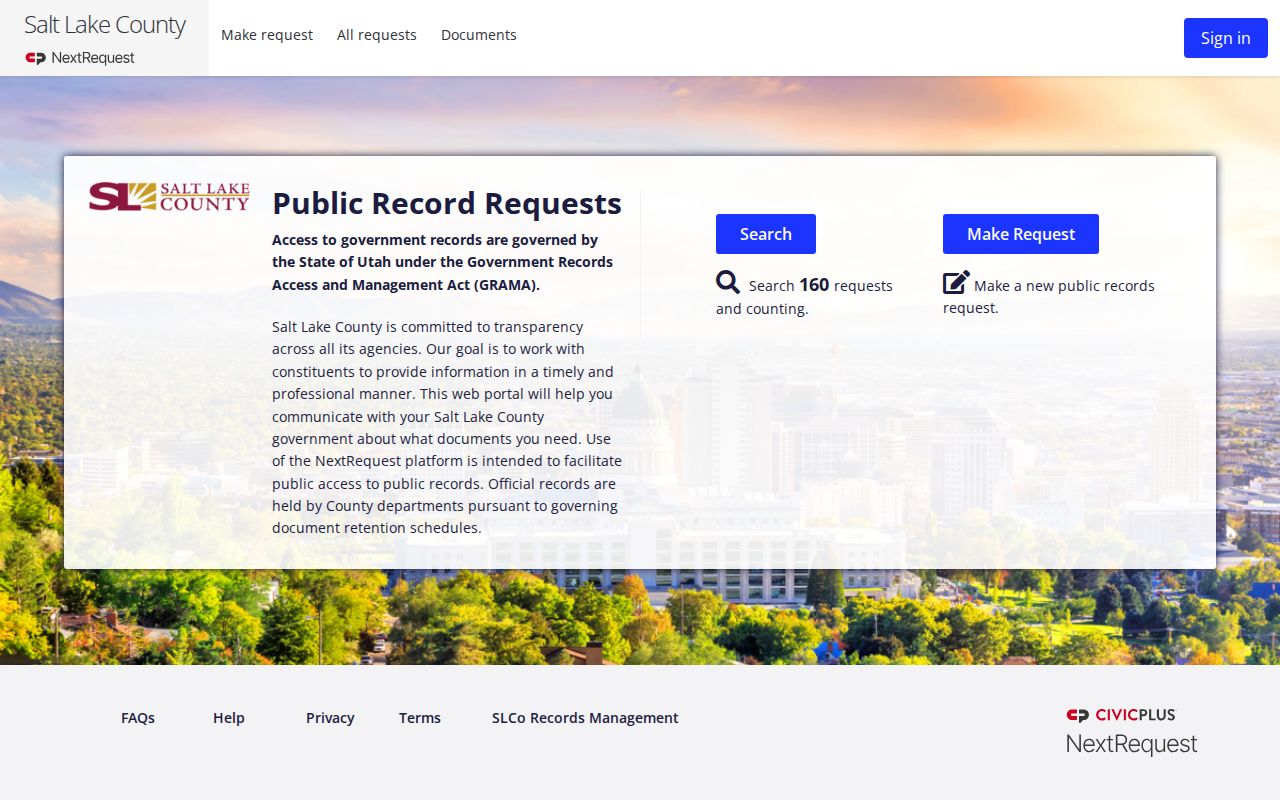
NextRequest is the county fallback when a needed historical record series is not available in the free index.
Use Granger and Hunter Names
West Valley City incorporated July 1, 1980. Earlier land and household records therefore belong to earlier communities. City history records Harker settlement in 1848, Granger settlement in 1866, Hunter families, the Granger-Hunter Improvement District in 1950, postwar subdivisions, and agricultural places such as Winder Dairy and Fassio Egg Farms. A modern house can be described as Granger, Hunter, Chesterfield, Salt Lake County, or a subdivision in a pre-1980 source.
Search the street, parcel’s subdivision, and historic place label together. The 1959 suburban directory includes Granger and Kearns-area material, while the 1980 Salt Lake City Suburban Directory explicitly includes West Valley City. The transition is a useful bridge, not evidence that an older volume used the modern city name.
Find Past Households in Polk
Utah Historical Society’s house-history guidance says the address sections, known as Polk “pink pages,” can answer who lived in a specific house after 1924. Locate the correct volume, find the street and number, verify the abbreviation key, and record the page. Then check the name section for spelling, occupation, employer, spouse or relationship notation, householder mark, and cross-reference. A reverse entry is a lead to a past occupant, not a claim about a current person.
For a pre-1924 house, the Research Center recommends Preservation Office house files and newspapers, supported by Recorder and Assessor work. The research did not locate a complete WVC criss-cross run or uninterrupted annual directory series. Ask the Research Center at 300 S Rio Grande, Salt Lake City, or a County Library branch for the volume and address section that fits the year.
Build a Dated Backward Trail
Use the strongest available year, then step backward rather than assuming continuity. Each source has a different time pattern and meaning.
| Source | Coverage found | What it adds |
|---|---|---|
| Recorder | Permanent county series; exact online start year not stated | Transfers, encumbrances, legal descriptions |
| Directories | 1894-95, 1915, 1919, 1959, 1974, 1977-78, 1980 examples | Names, addresses, occupations, reverse leads |
| Census | Released schedules under the 72-year rule | Household composition and place |
| Birth/death indexes | Salt Lake birth 1890-1915; death collections 1849-1949; state index 1905-1970/75 | Family and life-event clues |
| Newspapers | Dates vary by title and collection | Obituaries, sales, weddings, civic mentions |
| Probate/Xchange | Case-specific public summaries and files | Estate, heir, and filing context |
A no-hit year can mean a missing volume, different place name, renter, parcel change, spelling problem, privacy limit, or unindexed source. Record the reason you stopped.
Use Obituaries and Probate Carefully
The County Library’s Utah Digital Newspapers, Utah NewsSearch, Chronicling America, and genealogy databases can reveal a death notice, marriage, land transaction, subdivision advertisement, or civic mention. Search both the name and address, plus Granger, Hunter, Chesterfield, and Salt Lake County. A death index may supply a date or county while an obituary names relatives. FamilySearch cemetery records can add burial or deed-register clues, but the Salt Lake City Cemetery collection is not a WVC municipal cemetery index.
For an estate, search Utah Courts Xchange for a probate case, read the public docket, and ask the clerk for a permitted file. Then compare the Recorder transfer. Heirs and estate addresses may be private or redacted. Do not publish a living person’s address merely because it appeared in an old notice or filing.
Read West Valley City’s Growth
Address history follows the built form. Early farm parcels and interurban corridors became 1948-62 subdivisions. Granger High opened in 1958, Valley Fair Mall arrived in 1970, the E Center in 1997, and TRAX reached the West Valley line in 2011. These milestones can help date a neighborhood newspaper search, but they do not identify a household on their own. A parcel may move from a farm tract to a lot and block, so the legal description is the bridge.
Population and place terms also shift. City history gives an incorporation population of 72,509 in 1980 and 86,976 in 1990; Census QuickFacts gives 140,230 in 2020. Those figures are context for changing records, not a count of a particular street. Search old labels before assuming a modern city-name absence means no record exists.
Request the Missing Record
Salt Lake County Records Management describes long-term holdings from 1852 forward and routes county requests through NextRequest. Use a narrow request that names the office, address or parcel, record type, date span, and public fields. For example, request a specified deed index entry, plat, or address-linked series, not “all prior residents.” Utah GRAMA classification controls what can be inspected, copied, or redacted. A city-held document goes to West Valley City’s custodian.
Ask for electronic inspection and a fee estimate. The county Recorder publishes ordinary, historical, and certified-copy routes. A request can uncover an archive series that is not online, but it cannot create a complete occupant list or force release of private, protected, sealed, or controlled material.
Where the Backward Trail Ends
The record trail may stop at a renter, a household member not named in a filing, a protected voter, a Safe at Home participant, a sealed court case, a restricted vital record, or an unindexed directory. No deed does not mean no past resident. No directory line does not mean an empty house. An owner mailing address does not prove occupancy, and a current owner is not necessarily the person who lived there before.
Lawful use. West Valley City house-history records are for genealogy, property history, estate work, and civic research. Do not use an old name or address to stalk, harass, intimidate, or harm anyone. Verify material facts with the custodian.
Preserve the original address, place label, parcel, source year, page, and uncertainty. That habit makes a previous-residents search useful without turning a historical clue into an unsupported current claim.